Pocket Watches vs. F1 Cars: What Are You Really Optimizing For?

There are two very different paradigms for building complex things.
Both can produce beautiful results. Both require deep expertise. Both can be sources of pride for the people who build them.
Only one is designed to survive contact with reality.
The Pocket Watch Paradigm
A custom pocket watch with multiple complications is a marvel of engineering.
Each component is hand‑fitted. Nothing is interchangeable by accident. Every gear, spring, and jewel is tuned to work in harmony with the others. When it’s finished, the result is a precise, elegant mechanism that feels almost alive.
It is also extraordinarily delicate.
When something goes wrong, you don’t “recover” quickly. You stop. You open the case. You inspect every interaction to understand what no longer fits. Repairs require specialists with deep, narrow expertise. Replacement parts are often bespoke. Validation comes from expert judgment and careful manual inspection.

This paradigm optimizes for bespoke perfection and mastery of the craft.
And it maps uncomfortably well to how many organizations build software.
They organize around specialized roles and functional silos. Work moves through a sequence of handoffs. Before every release, people manually verify that all the pieces still fit together. Confidence comes from reviews, approvals, and checklists rather than from the system itself.
The software may look impressive on paper, but it is slow to change, expensive to operate, and increasingly frightening to touch once it is running in production.
The F1 Car Paradigm
Now consider a Formula 1 race car.
It is also a custom‑built work of mechanical art. Nothing about it is generic. Everything is engineered to extreme tolerances. The people who build and operate it are among the best in the world at what they do.
But the defining question behind every design decision is different:
How fast can we respond when something goes wrong?
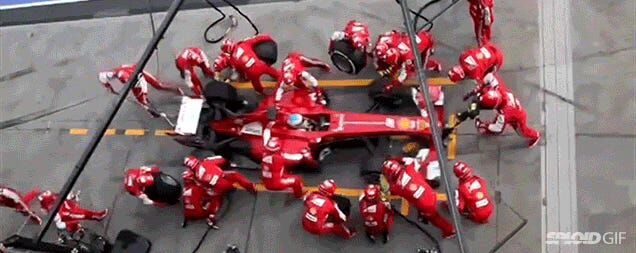
Tires are replaced in roughly two seconds. Entire assemblies are designed to be removed and swapped without debate or ceremony. Even an engine can be replaced in hours, not weeks.
An F1 team does not pause a race to carefully inspect whether each part is still conceptually correct. The same people who designed and built the car are the ones servicing it on race day. There is no handoff to a separate group that must relearn intent under pressure. They replace the part, get the car back on track, and analyze the failure afterward, when the system is no longer bleeding time and position.
This paradigm is optimized for operational responsiveness and uptime.
And this is the paradigm modern software organizations must adopt if they care about reliability, safety, or speed.
Software Is a Live System
Software is not a static artifact that you build once and admire.
It is a live system operating in an environment that changes constantly. User behavior evolves. Dependencies fail. Security threats emerge. Requirements turn out to be wrong or incomplete. Assumptions that once seemed reasonable quietly rot.
In that world, failure is not an exception. It is an inevitability.
If your response to failure requires assembling a committee, reconciling versions across multiple systems, and manually verifying that everything still fits together, you did not design for operations.
You built a pocket watch.
Why Functional Silos Collapse Under Pressure
You cannot design for operational readiness if your organization is built around functional silos.
Structures like product management teams optimizing for plans, development teams handing work off to release management for eventual delivery using manual version tracking and artifact reconciliation, and compliance enforced through checklists all share the same assumption: that risk is reduced by slowing change and inserting more inspection.
That assumption only holds in calm, best‑case conditions where no one makes mistakes and time doesn’t matter.
When something is actually broken or when revenue, safety, or mission outcomes are at stake, those processes become obstacles. They are slow, fragile, often bypassed entirely in emergencies and some offer only imaginary safety which means they were never really protecting you in the first place.
No Formula 1 team would design a components and a pit crew that only works when the track, weather, components, and other drivers are all perfect.
Replaceability Beats Perfection
Operational readiness comes from a different set of design goals.
Instead of optimizing for perfect assemblies, you optimize for rapid, safe replacement. Instead of relying on humans to inspect quality at the end, you build automated validation into the system itself. Instead of separating responsibility across teams, you give teams end‑to‑end ownership of what they build and run.
This is why continuous delivery matters.
Not because speed is fashionable, but because the ability to make small, safe, routine changes is what allows you to respond when things go wrong. If fixes require a special process, heroics, or exceptions to the rules, your system is already brittle.
If you cannot confidently deploy a change today, you are not prepared for an incident tomorrow.
The Organizational Consequence
You do not get F1‑level operations by adding better tools to a pocket‑watch organization.
The architecture, delivery pipeline, team structure, quality process, and governance model all have to be designed around the assumption that failure will happen and recovery must be fast.
Replaceability is not an implementation detail. It is an organizational value.
Choose Your Paradigm
Pocket watches are beautiful. They deserve admiration.
They belong in display cases.
If your software is mission‑critical, revenue‑critical, or life‑critical, mechanical elegance is not the goal. Resilience is.
You need a race car.
Design everything — especially the organization that produces the software — for operational readiness.
Because uptime is not a feature you bolt on at the end.
It is the natural outcome of the design choices you make from the very beginning.